| VIEW IN BROWSER | |
In this fall quarter issue, you'll find practical support for teaching and learning at Northwestern. Discover strategies for learning student names, resources for navigating AI in teaching, opportunities to connect with colleagues across the University, and upcoming CIRTL Network offerings available to the Northwestern community. You'll also meet our newest fellows, learn how graduate instructors are preparing for teaching success, and hear from University Teaching Award recipient Connor Bain on learning, AI, and the value of productive struggle. Take our brief reader survey to help us shape the content for future issues. Engagement Opportunities | Practical Strategies | Timely Resources | Partnerships | Community Highlights | Faculty Spotlight on Connor Bain  | |||||||||||||||||||||
Members of the Northwestern community can access professional development opportunities offered through the Center for the Integration of Research on Learning and Teaching (CIRTL) Network. Designed for graduate students and postdoctoral scholars from a wide range of disciplines, these programs and communities of practice support effective, inclusive, and relationship-rich teaching. We recommend the following upcoming offerings, which count toward completion of our CIRTL @ Northwestern Certificate Program. | |||||||||||||||||||||
| |||||||||||||||||||||
CIRTL @ Northwestern is made possible through the support of The Graduate School, the McCormick School of Engineering, Weinberg College of Arts and Sciences, and the Feinberg School of Medicine.  Learning Student NamesBy Greg Siering, Director of Pedagogy and Curricular Development Research consistently shows that a student’s sense of belonging is a primary predictor of retention and persistence (Strayhorn, 2018; Gopalan & Brady, 2020). But long before a student decides whether they fit into a university, they decide whether they fit into a classroom. When an instructor addresses a student by name and remembers something about them, studies show that it reduces psychological distance, encourages office-hour visits, and significantly increases class engagement (Cooper et al., 2017). Using students’ names signals caring, personalizes learning, and builds the kinds of relationships that can foster academic integrity. As faculty navigate varying classroom support structures, learning dozens or even hundreds of student names in a large-enrollment course can feel particularly daunting. Yet, remembering and using student names remains one of the best strategies for boosting student belonging and success. While some of us are naturally gifted at connecting faces to names—what psychologists call strong associative memory—there are practical, low-lift techniques anyone can use to manage this independently. In A Teacher’s Guide to Learning Student Names (2024), Michelle Miller provides several strategies to help get started, including the following. Retrieval PracticeRetrieval practice is a powerful tool for student learning, and it can be just as helpful in learning student names. Instead of “cramming” by studying a student roster, we can practice retrieving students’ names by actively using them in class. If you are worried about mispronouncing students’ names, consider using NameCoach, a Canvas tool that allows students to record the pronunciation of their names, which can give you (and their classmates) confidence in using their names in class. Photo RostersPhoto rosters are particularly useful prior to a class, letting you get the jump on remembering names, or for double-checking your memory later. I often jot notes on a printed photo roster to help build additional associations that trigger my memory—an interesting fact or interest shared in class. Learn how to view and print photo rosters in Caesar. | |||||||||||||||||||||
| |||||||||||||||||||||
The Science of How Students Learn Practicum Explore innovative, evidence-based strategies grounded in core learning principles—not only to navigate the rapidly evolving landscape of higher education, but to shape its future. This Open Educational Resource offers Northwestern's 2025–26 University Practicum as a self-guided online learning experience. Supporting Faculty Engagement with the Campus Reading ProgramAs common intellectual experiences, campus reading programs are a high-impact practice that have been shown to deepen student learning and increase rates of engagement, retention, and persistence. The Searle Center is partnering with the Campus Reading Program sponsored by the Litowitz Center for Enlightened Disagreement and the Office of Community Enrichment to support faculty engagement with this year's selection—Vigil by George Saunders. Our collaboratively created learning & teaching guide offers multi-disciplinary approaches to connect students with the text. Whether used for a class discussion or co-curricular learning activity, the guide provides adaptable approaches for fostering reflection, dialogue, and meaningful engagement with Vigil. The new Campus Reading Program Engaged Learning Grants provide up to $500 to support innovative course activities and learning experiences connected to Vigil. Congratulations to the grant's first recipient, Henry Castillo from the Department of Theatre. Castillo will incorporate Vigil into his Transnational Theatre and Collective Creation in the Americas course this fall with a two-session residency led by theatre-maker and scholar Khristián Méndez Aguirre. Students will explore themes of witnessing, care, collective responsibility, and environmental justice through discussion and performance-based practice. By connecting the shared campus text to contemporary environmental performance and community-engaged theatre, the project exemplifies the kinds of creative, interdisciplinary learning experiences that the Engaged Learning Grants are designed to support. Interested in applying for the grant? Funding may be used for guest speakers, performances, exhibitions, course materials, and other opportunities that enhance learning in and beyond the classroom. Applications are currently being accepted for the 2026–27 academic year, and proposals from all disciplines are welcome. Learn more and apply.
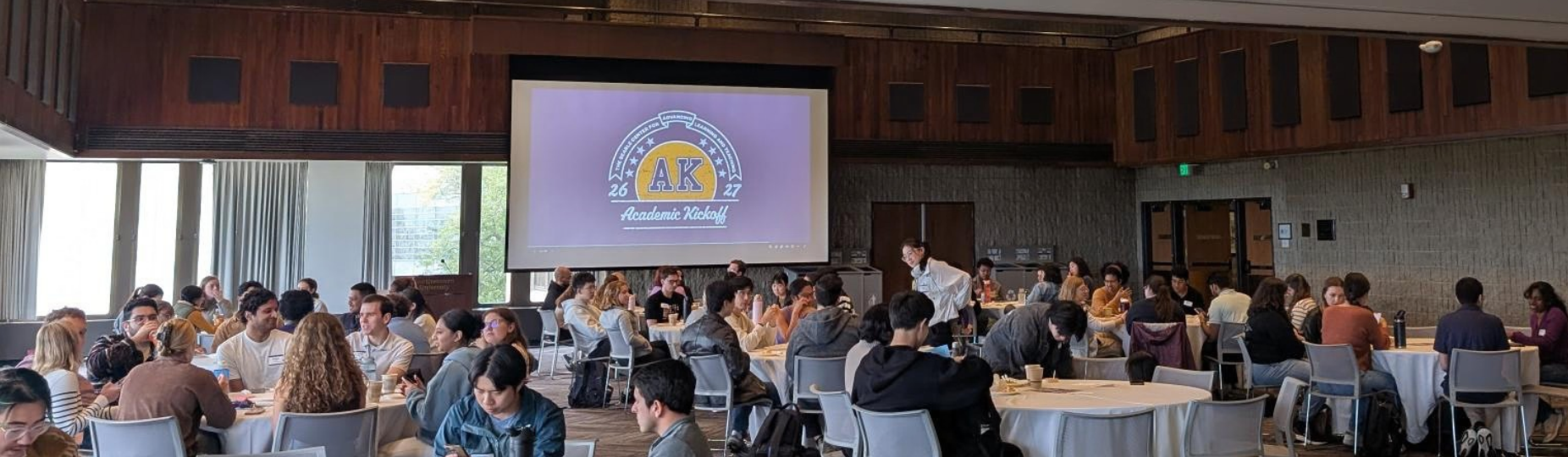
Academic Kickoff Prepares New TAs for Teaching SuccessOn September 22, Dean of The Graduate School Kelly Mayo welcomed more than 80 of Northwestern's newest graduate student teaching assistants (TAs) to the Academic Kickoff. In his remarks, Dean Mayo highlighted the important role TAs play in supporting undergraduate education. TAs extend faculty members’ ability to engage students in active learning, provide meaningful feedback that supports academic progress, and offer the personal attention that helps students thrive. As key points of contact for students, TAs also help create the learning experiences that define a Northwestern education. Transformative learning experiences are at the heart of the Academic Kickoff. Designed for graduate students teaching at Northwestern for the first time, the program helps participants build confidence and develop practical teaching skills before entering the classroom. Through peer-led, interactive sessions facilitated by experienced graduate instructors, participants explored strategies for engaging students, fostering belonging, delivering effective feedback, and building productive relationships with both students and lead faculty. One popular session, "Real Stories, Real Solutions," was led by Graduate Teaching Fellows Kahlil Oatis and Sierra Rosetta. Drawing on their own teaching experiences at Northwestern, they prepared new TAs for the first weeks of the quarter through practical tools, candid advice, and case studies. Participants discussed how seemingly small decisions can shape classroom dynamics and student perceptions from day one. Conversation centered on professional identity in the classroom, including professional presentation, social media boundaries, expectations around forms of address, and decisions about what personal information to share with students. Oatis and Rosetta encouraged participants to think proactively about these choices as a way to establish credibility, foster respectful learning environments, and focus attention on student success. The Academic Kickoff reflects Northwestern's investment in preparing graduate students to be effective educators from the start of their teaching journeys. By equipping new TAs with peer networks and a strong foundation in teaching, the program helps ensure that undergraduate students benefit from engaging, supportive, and high-quality learning experiences across the university. Welcoming Our New FellowsWe are proud to announce our newest cohorts! Each year, the Office of the Provost confers the University Teaching Awards on faculty members whose dedication to teaching transforms undergraduate learning. Recipients of the awards serve as Distinguished Fellows at the Searle Center, helping to strengthen Northwestern's culture of teaching excellence through engagement opportunities that share their expertise and creativity. At the awards ceremony last May, the newest Distinguished Fellows shared remarks that offered a powerful reminder of the ways great teaching transforms learning. Their reflections highlighted the importance of curiosity, authenticity, and human connection in the classroom. Whether encouraging students to approach learning with wonder, see the world through new lenses, or ask meaningful questions, these faculty members emphasized that teaching is about more than conveying knowledge. It is about inspiring students to discover, question, and grow. As we begin this new academic year, we are excited to learn from and collaborate with these exceptional educators. Their commitment to innovative, student-centered teaching reflects the spirit of Northwestern's teaching community and will help shape the work of the Searle Center in the years ahead. Elisa Baena, Spanish and Portuguese Connor Bain, Computer Science David O'Neill, Biomedical Engineering Sarah Rodriguez, Global Health Studies Scott Sowerby, History Aravindan Vijayaraghavan, Computer Science Sadie Wignall, Molecular Biosciences The Searle Fellows Program brings together early-career faculty committed to excellence in learning and teaching. As part of the year-long fellowship, participants design and implement action learning projects that explore new approaches to teaching, support student success, and address challenges in their disciplines. From improving scientific communication and medical training to developing authentic language learning practices, fellows' projects create lasting benefits for students, departments, and the broader Northwestern community. We are excited to partner with these remarkable faculty as they enhance student learning. Heidi Bai, Otolaryngology Ashley Budd, Anesthesiology Giorgia Chinazzo, Civil & Environmental Engineering Federico Ciardo, Civil & Environmental Engineering Mariana De Niz, Cell & Developmental Biology Jesse Gordon, Chemistry Kara Ingelhart, Pritzker School of Law Carolyn Keller, Integrated Marketing Communications Lucy Morse, Neurology Diego Pinto, Music Education Matt Rudolph, Medical Education Chiara Sotis, Economics Lisa Volpatti, Biomedical Engineering Christine Wang, Materials Science & Engineering Li Wang, Biochemistry & Molecular Genetics Nicole Wilson, Political Science Bo Zhang, Earth, Environmental, & Planetary Sciences Yiji Zhang, Computer Science 
By Laura Ferdinand, Assistant Director of Content and Communications Each quarter, we feature Northwestern educators doing innovative work in learning and teaching. These interviews showcase their educational journeys, signature styles, and how their teaching has been shaped by their work with the Searle Center.
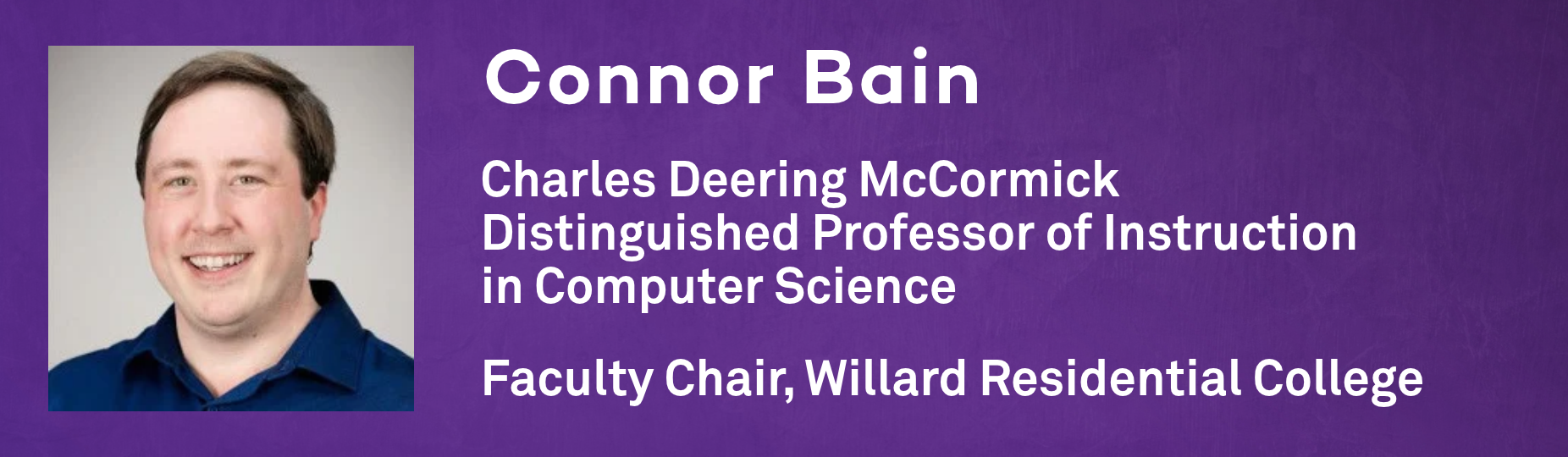
Bring up Connor Bain's name, and people light up. Amazing teacher! Amazing person! These sentiments were reflected last spring when he was honored with a University Teaching Award. I was lucky to converse with Connor over email in the days leading up to fall quarter, learning from his expertise at the intersection of computer and learning sciences. This is an excerpt from our exchange. Your research has long explored the intersection of student learning, computer science, and AI in education. In an era when generative AI tools are readily available to students, what lessons from your research feel most relevant today? My main research goal in my work has always been about empowering students and teachers with computational ideas. In earlier efforts, the democratization of computation relied on introducing as many people as we could to the art (and science) of programming. These days, with LLM-based tools, even someone who has never seen a line of code in their lives can quickly build a system that automates some task they find interesting / meaningful in their own lives. But it is also so tempting to surrender to these tools that which makes us human: our interests, our curiosities, and our struggles to learn the things we are passionate about. Learning is a messy process. It always has been. We learn by challenging ourselves, by pushing ourselves (or our students) past the precipice of the familiar and the comfortable. Learning to take that leap, learning what the landing feels like, learning what it means to stand back up afterwards—these are important steps! It’s not so different from the concept of muscle memory. Easy access to information and now easy access to synthesis has quickly started to change the way people interact with knowledge and learning. While I hope that will be a benefit for all (though history shows that’s not typically the case across those of differing identities, socioeconomic status, background, etc.), I worry too that knowing how to struggle to learn might be lost; that we will expect perfection far too early than is reasonable of a person still learning; that we will sacrifice learning fundamentals in favor of trying to rush to the end product. Learning is messy. It isn’t always neatly summarized in bullet points and the journey is just as important (if not more) than the product. | |||||||||||||||||||||
|







|
|
|
Copyright © 2026 Searle Center for Advancing Learning and Teaching |
