Northwestern's Strategic Framework for Assessment
Developed through the leadership, expertise, and sustained commitment of the Assessment and Accreditation Council, Northwestern’s 2026 Strategic Framework for Assessment articulates a clear mission and set of core values that center students, honor disciplinary cultures, and build capacity for meaningful, evidence-informed improvement.
Our role at the Searle Center is to support the faculty who bring the framework's vision to life. Each revised learning outcome, new method of assessing student work, mapped curriculum, or additional lens of student feedback helps build toward our shared commitment to reflective inquiry. Programmatic contributions to the Assessment Gallery enhance the visibility of this work, demonstrating how small, intentional acts accumulate into something powerful: a sustainable, relational, evidence-driven approach that supports student success. We look forward to supporting and celebrating your successes as we learn and grow together through the next decade of assessment at Northwestern.
Mission
Anchored in Northwestern University’s core values, assessment is a catalyst for educational transformation and innovation. Our faculty- and student-centered approach to assessment honors the local cultures within our schools, colleges, and co-curricular units, with processes guided by the leadership of the Assessment and Accreditation Council and the expertise of the Searle Center for Advancing Learning and Teaching.
We leverage the strength of Northwestern’s thriving culture of inquiry and interdisciplinary collaboration by engaging faculty, staff, and administrators in systematized and sustainable assessment practices that draw evidence from multiple perspectives to illuminate student learning and drive continuous improvement. Through this collective effort, assessment advances Northwestern’s institutional priority to deliver an outstanding educational experience for all students.
Vision
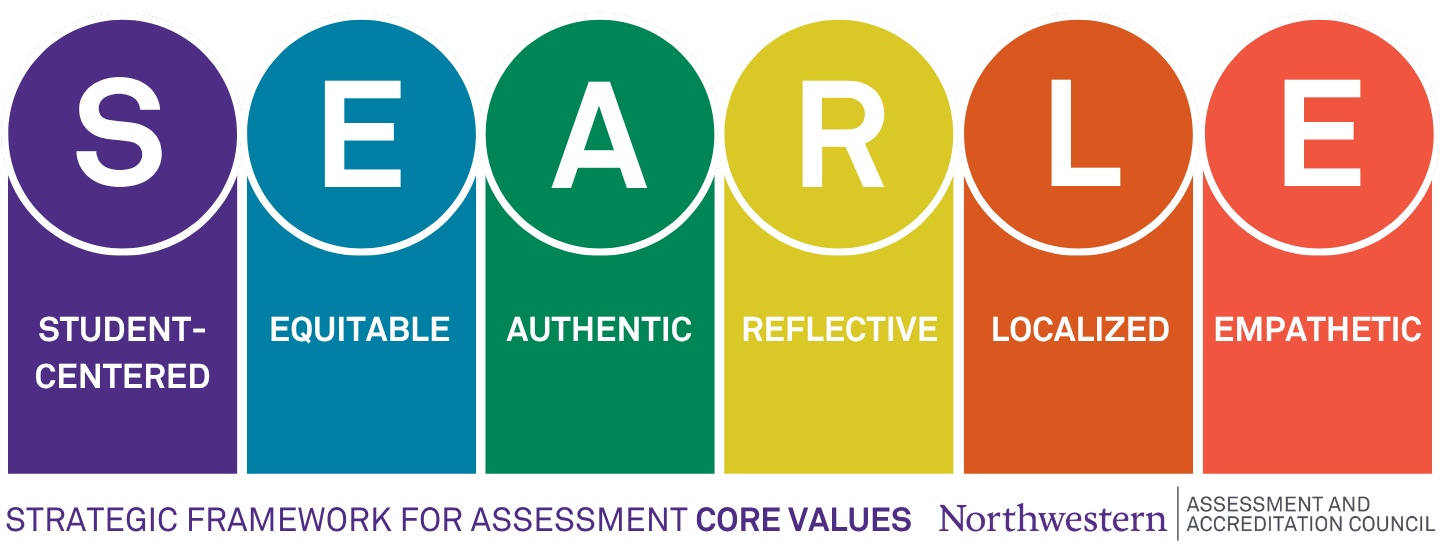
Core Values
The Searle Center has developed, and the Council has endorsed, a scholarly approach to assessment rooted in shared curiosity and grounded in a set of core values.
Together, we build capacity for educators to elevate student learning across curricular and co-curricular programs with assessment practices that are:
- Student-Centered: Assessment begins with a deep respect for students’ individual identities, backgrounds, experiences, and aspirations. We seek to understand how students learn and use those insights to create inclusive, engaging, and transformative learning environments.
- Equitable: Equitable assessment practices broaden the range of perspectives considered in the assessment process, removing barriers to student success. We promote accessible learning opportunities for all
- Authentic: Assessment is meaningful, relevant, and reflects real-world learning. We embrace a wide range of methods that align with disciplinary approaches and provide actionable insights for educators and students alike.
And we build capacity for colleagues to advance Northwestern University’s Strategic Framework for Assessment with assessment processes that are:
- Reflective: Our assessment processes are based on a continuous improvement cycle where evidence drives action for ongoing learning and meaningful change. We actively invest in professional development, collaborative learning communities, and reflective processes.
- Localized: Our assessment processes embrace a decentralized model that allows programs and schools to tailor assessment strategies to their unique teaching and learning contexts. We encourage flexibility and innovation while maintaining coherence through shared institutional goals and support.
- Empathetic: Our assessment processes are grounded in trust—built through non-judgmental listening and understanding throughout the assessment process. We are committed to being relational, holistic, context-aware, and supportive of meaningful growth.
Together, these values contribute to fostering a culture of assessment that empowers educators, supports students, and strengthens the University’s mission.
Northwestern’s Assessment Priorities
Northwestern’s assessment strategy recognizes that meaningful evidence of student learning is best generated through partnership across curricular and co-curricular programs. Led by schools, colleges, and units with institutional support, our approach is rooted in the assessment cycle, which prioritizes creating sustainable systems that help programs:
- Define and refine learning outcomes
- Design and redesign learning outcome assessment methods
- Map learning outcomes to curriculum
- Gather and analyze evidence
- Identify and implement changes
A key vehicle for this work is the Assessment Gallery, a public-facing platform that showcases how programs across Northwestern are using evidence to improve student learning. By making this work visible and searchable, the Assessment Gallery promotes transparency, shared learning, and accountability, while serving as a rich source of inspiration and practical examples of effective, evidence-based assessment practices that strengthen educational quality across the institution.
Visit our assessment cycle section to learn more about (re)defining, measuring, and mapping learning outcomes to the curriculum, and how we collect and use assessment data to drive curricular change.
Timelines and Targets (2025–2035)
The Framework includes short- and long-range targets aligned with Northwestern’s next accreditation cycle.
By Year 4 (2028–29)
- A majority of programs—including majors, minors, certificates, graduate and professional degrees, and co-curricular initiatives—will have clearly defined learning outcomes.
- Programs that have completed a full assessment cycle will have implemented curricular or programmatic changes.
By Year 10 (2034–35)
- All programs will have completed at least one full assessment cycle.
- All schools, colleges, and units will have clearly defined learning outcomes and mapped program-level outcomes to broader school, college, unit-level outcomes.
These targets promote shared responsibility for student learning, support evidence-informed decision-making, and sustain high-quality assessment practices to drive curricular improvement over time.
Contact Us
To discuss how your program can prepare a submission to the Assessment Gallery, set up a consultation with Lina Eskew, Senior Assistant Director of Assessment, or email lina.eskew@northwestern.edu.